For beekeepers across Africa, predators are one of the most common causes of colony loss. A single night of raiding can undo months of work, whether it is a honey badger tearing a hive apart or ants driving a colony to abandon its box. The encouraging news is that most of these losses can be prevented with simple, low-cost measures that local beekeepers can apply today.
Who Is Raiding the Hives?
Different predators call for different defences, so it helps to identify the threat first.
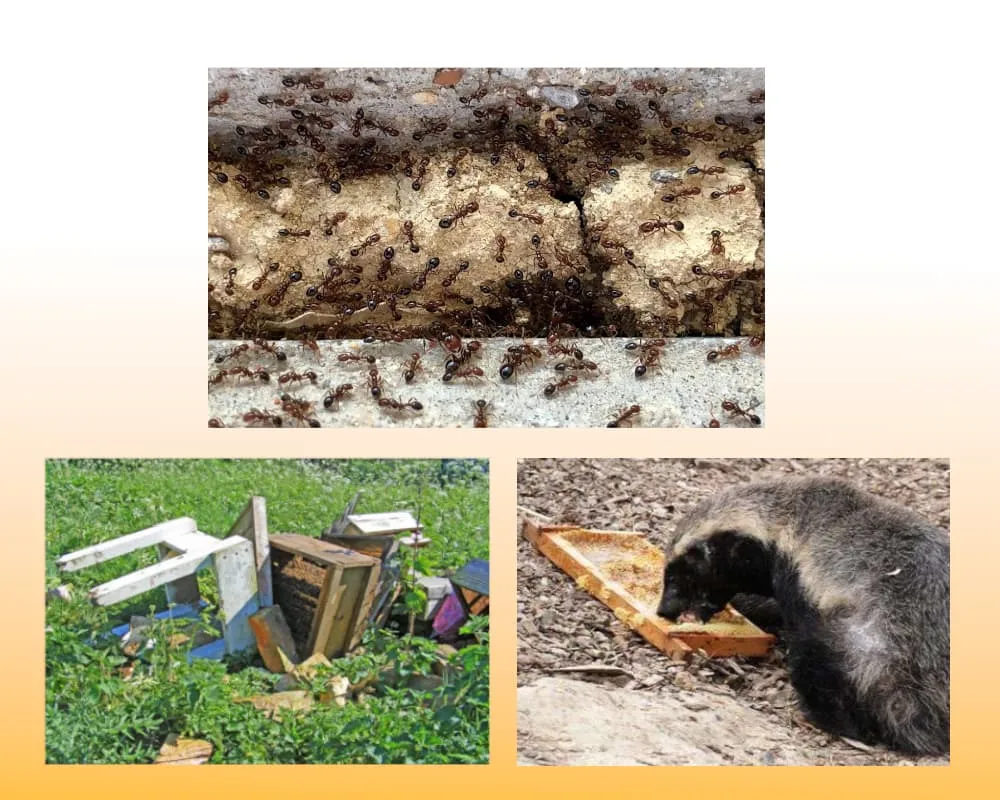
Honey badgers (ratels): the most destructive hive raiders in East and Southern Africa.
Ants: safari (driver) ants and carpenter ants invade hives to feed on honey and brood.
Bee-pirate wasps: common in dry, sandy areas, where they catch bees at the hive entrance.
Birds, monkeys and rodents: they damage combs and steal honey and pollen.
Thieves and vandals: a real risk in many areas, particularly for unattended apiaries.
Honey Badgers: What They Want and How to Stop Them
Despite their name, honey badgers are mainly after bee larvae, with honey as a secondary reward. This explains why raids are so destructive: the animal will tear the hive apart to reach the brood.
Some beekeepers turn to poison or steel traps, and the problem is growing in places where beekeeping is expanding into remote areas. These methods are harmful to wildlife and unnecessary. Physical barriers are cheaper, safer and proven.
1. Raise hives off the ground. African beekeeping guides recommend a minimum height of one metre, and some advise about 1.2 metres. At this height a honey badger struggles to reach or dismantle the hive. Stands can be built cheaply from timber, pipes, steel drums or old tyres. Always fasten the hive to the stand with strong wire so it cannot be knocked off.
2. Consider hanging hives. Suspending a hive from a tree branch on strong, twisted wire is a well-established method in Kenya. The hive swings when grabbed, so the animal cannot get a firm hold. Hanging hives also resist tipping by livestock and are harder for thieves to remove. The trade-off is that inspection and harvesting are less convenient, and relocating the hive takes more effort.
3. Use guard sheets and fencing. Where wooden poles serve as stands, a smooth metal sheet wrapped around the pole prevents climbing. A strong fence around the apiary adds another layer of protection against badgers, monkeys, livestock and people, and is worth the investment for larger operations.
4. Choose the site carefully. Avoid placing hives next to dense bush where badgers shelter. Clear grass and weeds around the hives to remove cover, and face entrances away from footpaths. A well-maintained apiary that is visited regularly is a less attractive target.
Ants: Small Raiders, Serious Losses
Ants eat honey, kill bees and brood, and can force a colony to abscond. Fortunately, they are easy to stop because they cannot cross a well-maintained barrier.
Oil or water traps: stand each leg of the hive stand in a tin of used engine oil or a cup of water.
Grease on legs and wires: a thick coat on stands and hanging wires blocks crawling insects. Reapply it regularly, as dust and rain wear it down.
Clear the surroundings: grass or branches touching a stand act as bridges, so keep vegetation trimmed back.
Seal the hive: cracks and holes invite ants and other intruders. Only the main entrance should be open.
Hanging hives are often easier to defend against ants than hives on stands, because there is only one route in, and a single greased wire is easier to protect than four legs.
Wasps, Birds and Other Pests
In dry, sandy regions, bee-pirate wasps can seriously weaken colonies. Providing shade, planting foliage around the hives and, in severe cases, moving the apiary are the most effective responses. Water traps with mirrors have also been used to lure and catch the wasps. Strapping lids down firmly limits damage from birds.
Predator-Proofing Checklist
Hives at least 1 to 1.2 metres above the ground
Hives wired securely to stands, or hung on strong twisted wire
Oil tins or grease on every stand leg and hanging wire
Metal guard sheets on pole stands
Vegetation cleared around each hive
No cracks, holes or loose lids
Shade provided in hot, dry areas
Fencing around the apiary where possible
Conclusion
Protecting an apiary is not about fighting nature. It is about making your hives a difficult target so predators move on. With a little planning, a few basic materials and regular inspection, most beekeepers can cut their losses significantly and protect the season's harvest.
Comments
0 comments