
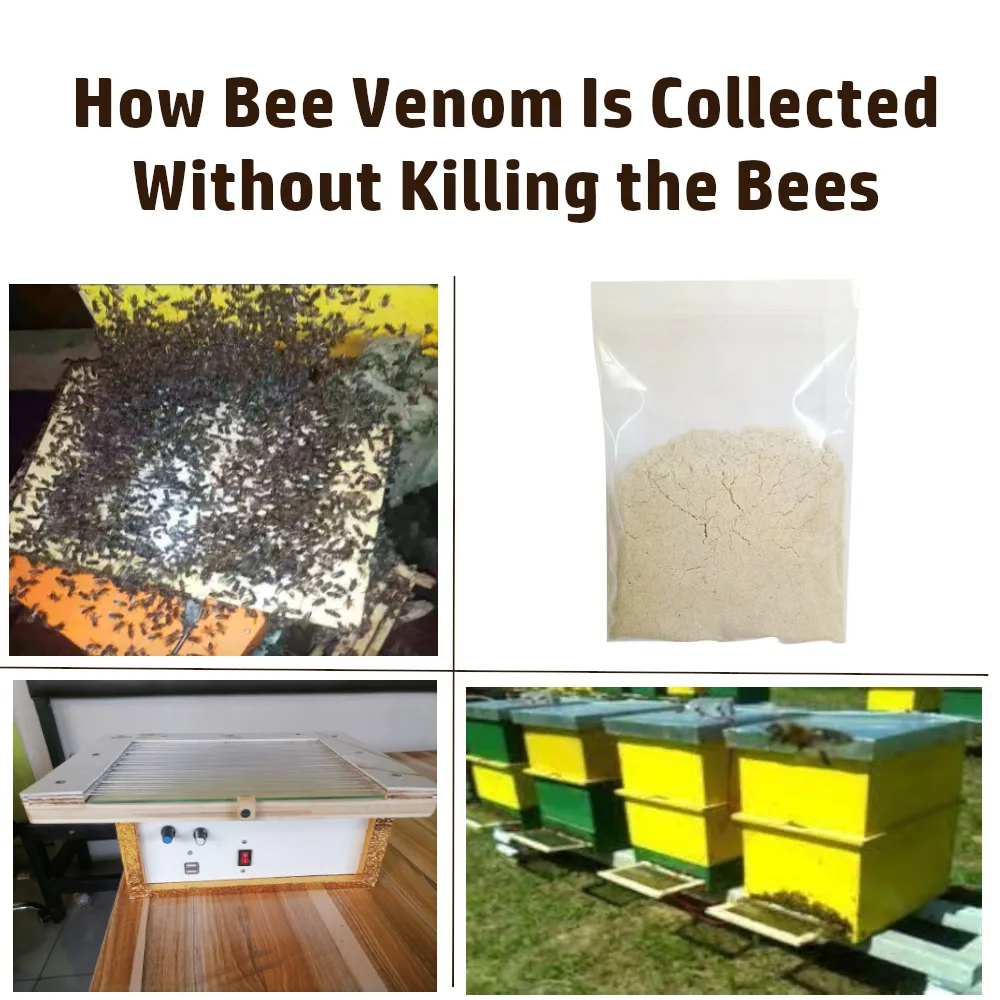
A honey bee that stings skin loses its stinger and dies. A honey bee that stings a smooth glass plate does not. That one difference is the secret behind modern bee venom collection, and it is why a well-run venom apiary can collect venom again and again from the same healthy colonies.
This article explains how the collector works, how the electric stimulation affects the bees, how long a session takes, and how a colony recovers afterwards.
Why the Bees Survive
When a bee stings a person or an animal, the barbed stinger catches in the flesh. As the bee pulls away, the stinger and part of her body are torn off, and she dies.
Glass is different. Its surface is hard and smooth, so the stinger cannot lodge in it. The bee releases a tiny droplet of venom, pulls her stinger back out and walks away. This is the principle behind every effective bee venom collector, and it is what makes the method non-lethal.
The Collector Device
Our collector has a control box and one or more collector screens.
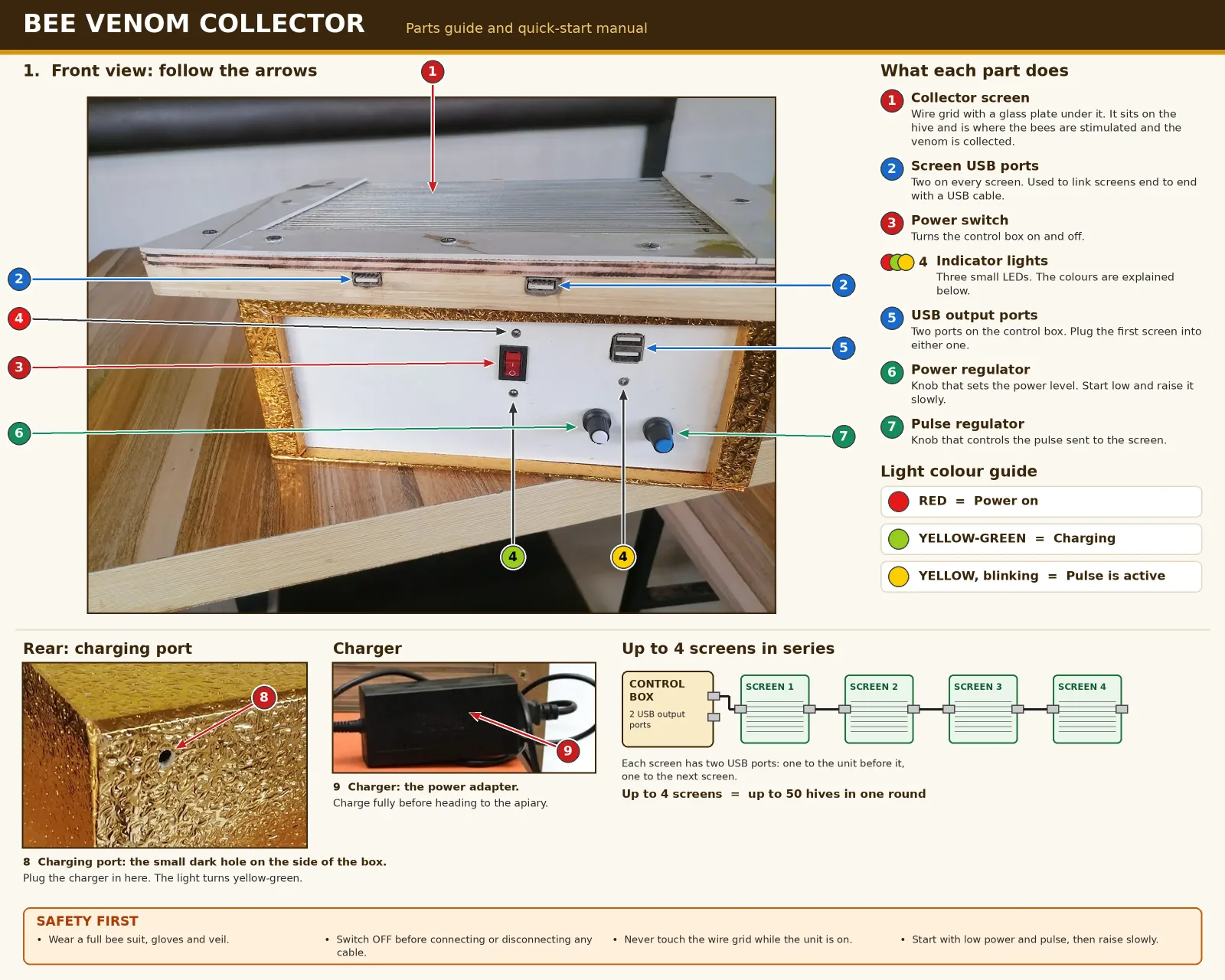
The collector screen is a frame holding a grid of thin wires, with a glass plate beneath it. The bees walk across the wires and the venom lands on the glass.
The control box supplies the power and sends short pulses to the screen. It has a power switch, a power regulator and a pulse regulator, and two USB ports for connecting screens.
Indicator lights show whether the device is on, charging or pulsing.
A charger keeps the unit ready for work.
You can link up to four screens end to end with USB cables, and the device can collect from up to 50 hives in one round. If you would like a closer look at each part, our guide to using the bee venom collector explains them one by one.
How to Set the Collector on the Hive
There are two common ways to place a screen. Which you use depends on your hive type and your routine.
1. On top of the hive. Open the hive and lay the screen across the top of the frames or top bars, so the wires sit where the bees move. The bees come up and cross the wires as they move about.
2. At the entrance. Set the screen at the hive entrance so the bees cross it as they come and go.
Either way, the screen must sit firmly and level, with the glass plate clean and in place, before you switch on.
Electric Stimulation: What the Power and Pulse Do
The collection works by giving the bees a very mild, short electric stimulus as they touch the wires. The bees react by stinging. Because they are stinging glass, they release venom without losing their stingers.
You control this with two knobs:
The power regulator sets how strong each pulse is.
Too low, and the bees barely react, so you collect little.
Too high, and the bees become very agitated and stressed, which can harm them and make the colony defensive.
The aim is the lowest level that makes the bees sting. That is why you start low and raise it slowly.
The pulse regulator controls the pulses the screen receives, including how they are timed.
Short pulses with pauses between them give the bees a chance to settle between stimuli.
A harsh or constant stimulus is more stressful, and bees that are stressed all the time collect less and recover more slowly.
In simple terms, power decides how hard the stimulus is, and pulse decides how it is delivered. A gentle setting protects the colony. The right balance gives a good yield without harming the bees.
How Long Does a Collection Take?
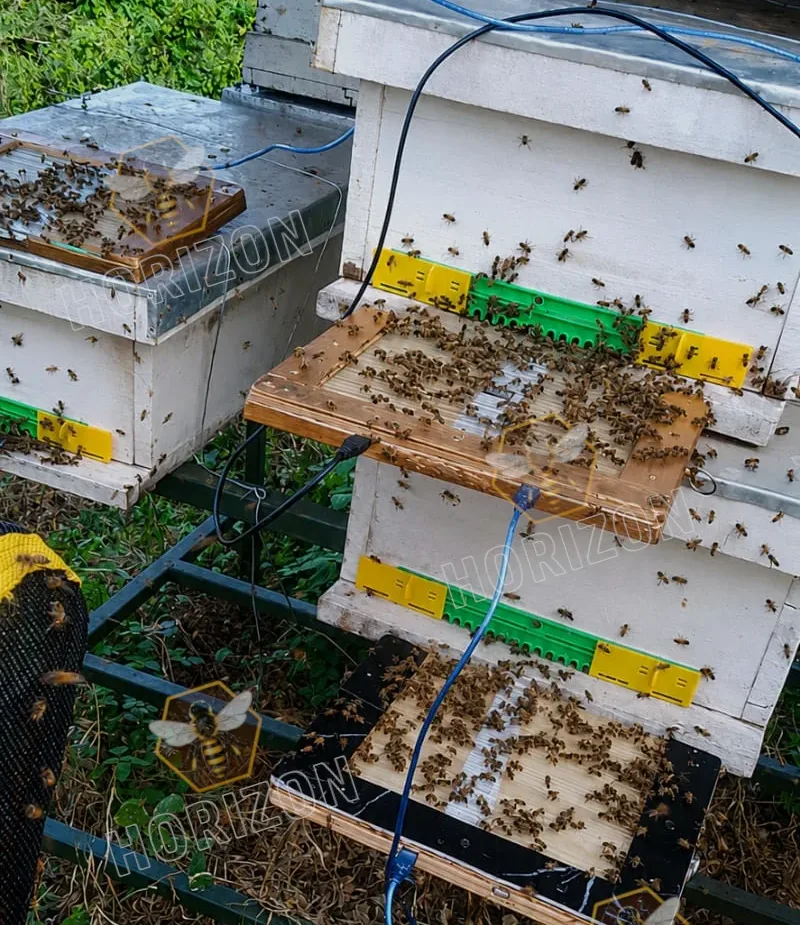
A session usually takes about 25 to 30 minutes per hive. There is a good reason for that. Bees release most of their venom early, and the amount drops quickly as the session goes on. Running the device for hours only stresses the colony and brings in very little extra. A short, well-timed session collects efficiently and is kinder to the bees.
One Screen, Many Hives
You do not need a separate screen for each hive. Because venom from one colony does not need to be kept apart from another, a single screen can be used on one hive, then moved to the next. That means you can collect from several hives in a round with just one screen, or work through more of your apiary at once when you connect up to four screens.
Between hives, simply keep the screen and glass clean and free of wax, propolis and debris.
How the Colony Recovers
Collection is not stress-free for the bees. The pulses and the alarm scent the bees release make the colony agitated for a while. But a healthy colony recovers well:
The bees keep their stingers and survive, so the workforce is not lost.
The colony calms down soon after the device is removed, and the bees go back to foraging and caring for the brood.
Rest between sessions matters. Give each hive time to settle before collecting from it again. Strong colonies bounce back faster than weak ones.
Good management keeps colonies productive. A hive that is well fed, well watered and free of pests handles the work much better than one that is struggling.
The practical rule is to collect from strong, healthy colonies, and to never push a hive that is still recovering.
The Best Times for Bee Venom Collection

Timing matters for your yield, for the bees, and for the safety of everyone nearby. Collecting makes the colony agitated, and agitated bees are more defensive than usual. So the first rule is to think about who and what is close to your hives.
Our recommendation: collect in the evening, from about 7:30 pm to 8:30 pm.
Here is why this window works well:
All the bees are home. By this time the foragers have returned, so the whole colony is in the hive and can be reached by the screen.
The bees are settled. They have stopped flying, and most have unloaded the pollen they carried on their legs, so they are calmer and easier to work with.
Fewer bees are flying around. With the colony inside, there is less chance of agitated bees chasing people, animals or neighbours.
Daytime collection is only for isolated apiaries. You can collect earlier in the day, when bees are active, but only if your apiary is far from people and livestock. Bees are more aggressive during a session, and in the daytime, they can fly out and reach anyone nearby. If people, cattle, goats or other animals are close, do not collect in the daytime.
A few extra tips for evening work:
It will be dark, so use a dim red light or a torch with a red cover. Bright white light draws bees toward you.
Pick a warm, calm evening. Avoid rain and heavy wind.
Make sure everyone nearby, including workers, family and neighbours, knows you are working, and keep them away from the apiary.
Leave the screen on the hive for the planned time only, then remove it and let the colony calm down.
Whatever time you choose, collect in the productive season, when flowers are plentiful and colonies are strong. Avoid lean, dry periods, when colonies are already under strain.
Mistakes to Avoid
We will cover what to watch for during a harvest in a later article, but a few rules are worth knowing from the start:
Do not collect from weak or struggling colonies.
Do not collect in the daytime if people or livestock are close to your hives.
Do not start with high power. Begin low and raise it slowly.
Do not run a session for longer than planned.
Do not collect again from the same hive without a proper rest.
Do not collect in rain or in the wet of early morning.
Do not touch the wires while the device is on, and always switch off before connecting or disconnecting cables.
Do not work without full protective gear, and never allow anyone with a history of serious reactions to stings near the apiary.
Frequently Asked Questions
Does bee venom collection kill the bees?
Not when it is done properly. The bees sting a smooth glass plate, so they keep their stingers and survive.
Is bee venom collection painful for the bees?
The stimulus is meant to be mild and brief, but it is a stress for the colony. That is why settings, session length and rest periods matter.
How long does a session take?
About 30 minutes per hive.
Can one screen collect from several hives?
Yes. Venom from different colonies does not need to be kept separate, so one screen can be moved from hive to hive, with the glass kept clean.
How many hives can the collector handle?
With up to four screens connected, it can collect from up to 50 hives in one round.
When is the best time to collect bee venom?
In the evening, from about 7:30 pm to 8:30 pm, when all the bees are back in the hive and settled. Collect in the daytime only if your apiary is far from people and livestock.
Can a beginner do this?
Yes, with proper training and the right protective gear. Start small and learn the routine first.
What Comes Next
Collecting the venom is only the first half of the process. In our next article, we look at how to scrape, store and handle bee venom safely so that it keeps its quality.
Bee venom collection should be done by trained people wearing full protective gear. Bee stings can cause severe allergic reactions in some people, so seek medical help immediately if someone reacts badly.

Comments
0 comments