
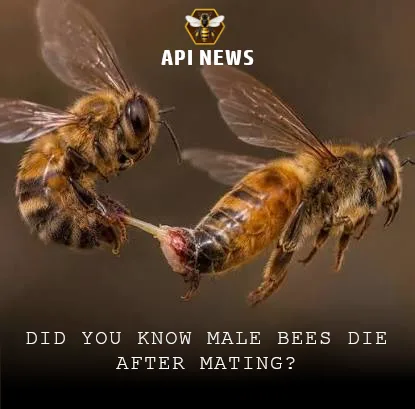

Yes, drones die after mating. When a drone succeeds in mating with a queen, he is fatally injured in midair and falls to the ground, where he dies within minutes. This is one of the most remarkable events in the life of a honey bee colony. Here is how it happens, when the queen makes her flight, and what she does afterwards.
The Drone
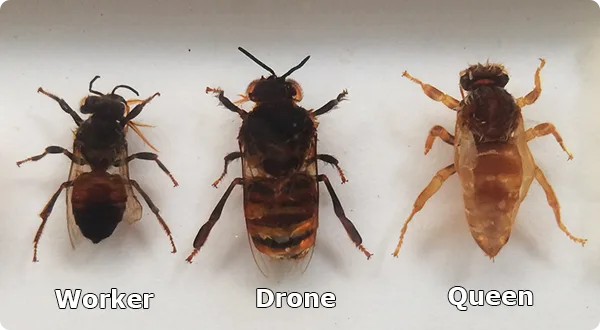
The drone is the male honey bee. He is larger and rounder than a worker, with big eyes, no stinger and no pollen baskets. He does not forage, clean or guard the hive. He develops from an unfertilised egg, takes about 24 days to grow, and becomes sexually mature at around 12 days old. From then on, his one purpose is to find a queen.
The Queen’s Timeline
Stage | When | What happens |
|---|---|---|
Emergence | About 16 days after the egg is laid | The virgin queen leaves her cell |
Maturing | First few days | Her body and scent develop, and she takes short orientation flights |
Mating flights | Usually 5 to 14 days after emerging | She flies out on a warm, sunny, calm afternoon |
Each flight | Roughly 12 to 30 minutes | She mates with several drones in the air |
Number of flights | Usually 1 to 3, over a few days | Rarely more |
Return | The same day | She comes back, sometimes carrying a “mating sign” |
First eggs | About 2 to 4 days after mating | She begins laying |
Do Drones Die After Mating? How the Mating Flight Works
Mating takes place in the air, in a specific kind of location known as a drone congregation area.
Drones gather. On warm afternoons, drones from many colonies fly to the same area, usually 10 to 40 metres above the ground. These areas often stay in the same place for years, even though the drones that gather there die each season.
The queen arrives. She leaves her hive and flies into the area. Her scent attracts the drones, which follow her in a swirling cloud called a comet.
Mating. A drone catches her in flight and mates with her. It takes only seconds.
The drone’s death. During mating, part of the drone’s reproductive organ is torn from his body and remains with the queen. He falls to the ground and dies shortly afterwards.
The next drone. The next drone in the comet removes what the previous one left behind, mates, and meets the same fate.
A queen typically mates with around 12 to 15 drones, and sometimes more, before returning to the hive.
Why Mating Is Fatal for the Drone
![MATIN]](https://issksogxqzbyvaokdvsp.supabase.co/storage/v1/object/public/article-images/2026/11/1793617888502-x5zmbl-images.webp)
The organ the drone uses is designed to lock in place and breaks off during mating, which is fatal for him. The result, though, is vital for the colony. The queen stores millions of sperm in a small organ called the spermatheca, and uses them for the rest of her life.
Mating with many drones also gives the colony a wide mix of genes. That diversity produces workers with different strengths, such as foraging, defence and hive maintenance, and makes the colony more resilient.
What Happens After the Mating Flight
After her flights, the queen returns to the hive, and the workers remove any mating sign she carries. Within about two to four days, she begins laying eggs. She will continue to lay for the rest of her life, which can last several years.
She does not leave the hive for mating again. The only time she goes out is when the colony swarms, and that may be a year or more later. Mating happens only in the first weeks of her life.
Weather can interfere. Rain, strong wind or cold can delay her flights. If she cannot mate within roughly three to four weeks, she may begin to lay only drone eggs, and the colony will need a new queen.
The Drones That Never Mate
The great majority of drones never get the opportunity. They spend their short lives eating, flying and waiting, and when food becomes scarce, the workers push them out of the hive. Their role is brief, and for most it ends without mating.
What Beekeepers Can Observe
You are unlikely to see the mating itself, because it takes place high in the air. But you can look for signs that it has happened:
Drones flying in the afternoon during warm, calm weather
A queen returning with a small white thread at the tip of her abdomen
Eggs in the cells a few days after her return
Avoid opening a hive while a new queen is out on her mating flights, since disturbing her can put her at risk.
Practical Lessons for Beekeepers
Keep some drone brood. Well-mated queens depend on a healthy supply of drones in your area.
Leave new queens undisturbed during their mating period.
Pay attention to the weather, since good conditions give better-mated queens.
When rearing queens, allow roughly two to three weeks from emergence until she is mated and laying.
Learn More About Queen Rearing
Raising your own queens is a skill that can strengthen your apiary and cut costs. We offer training for beginners, and our shop stocks queen rearing tools, from grafting tools to queen rearing frames and cages. You can reach us here: https://horizonbeeafrica.com/contact
Understanding how drones and queens mate helps you manage your colonies with confidence, and gives you a deeper appreciation for the bees in your care.


Comments
0 comments